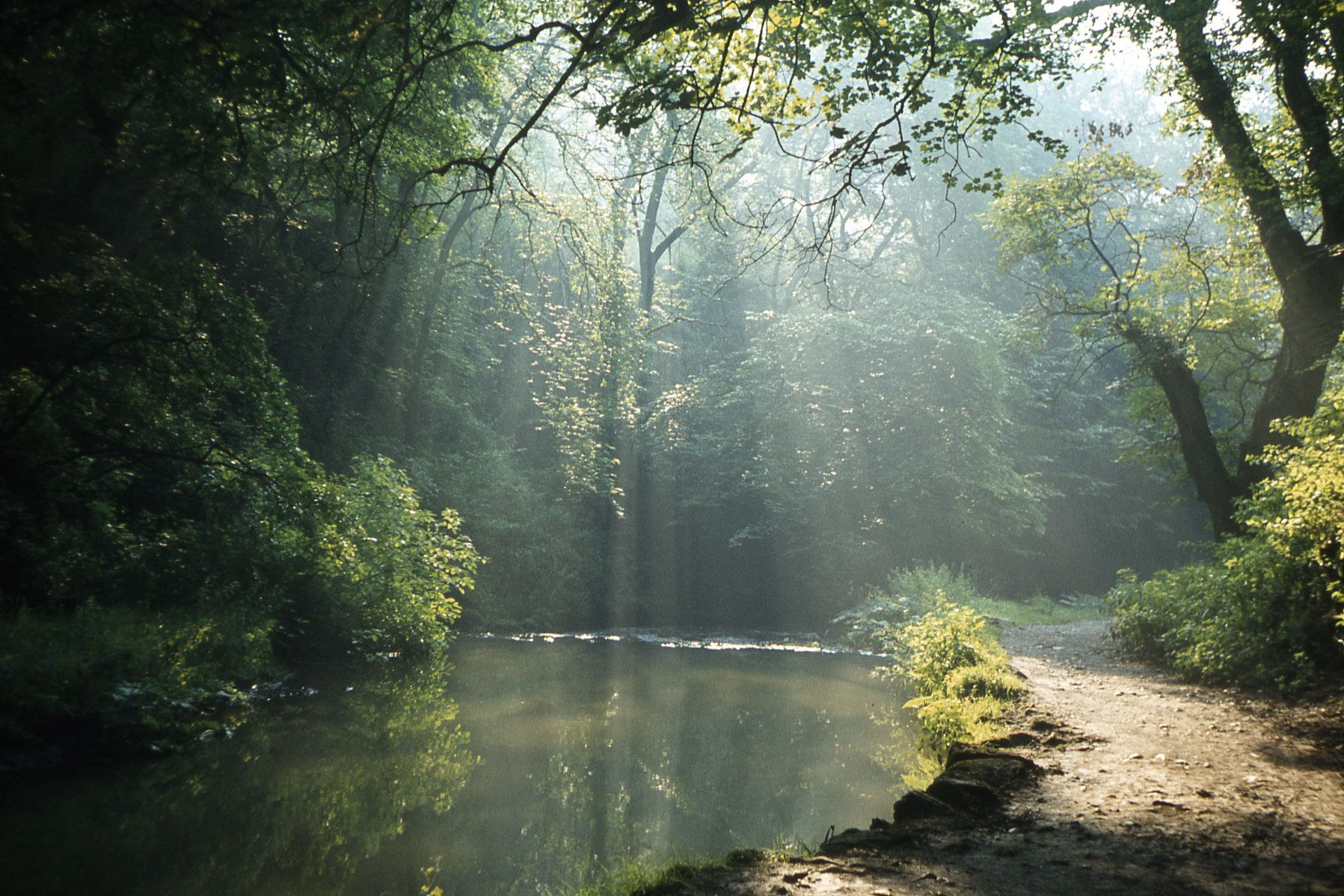
The story begins with water, a crossing, and a small corner of the English landscape.
Beresford is a habitational surname: a name taken from a place. The Dictionary of American Family Names, reproduced by FamilySearch, connects it to Beresford in the parish of Alstonfield, Staffordshire. It explains the name through Old English beofor — beaver, or possibly a nickname derived from that word — and ford, a river crossing. [1]
An early recorded spelling is John de Beveresford. [1]
OLD ENGLISHbeoforbeaver, or a related byname
+
OLD ENGLISHforda shallow river crossing
→
A PLACE BECOMES A SURNAMEBeresfordthe name travels with its bearers
02 / THE LANDSCAPEFOLLOW THE RIVER
BERESFORD DALE · PHOTOGRAPH BY COLIN PARK
A quiet dale. An enduring connection.
Beresford Dale lies near Hartington, where the River Dove flows between wooded banks and limestone cliffs. Small weirs interrupt the water; paths follow the valley. The local destination organisation describes a compact, quieter counterpart to nearby Dovedale. [2]
For anyone curious about the name, this is a fitting place to begin: a real landscape to set beside the words in a record. The surname’s Staffordshire connection and the dale’s Peak District setting belong together. [1][2]
Manorial records, a church monument, an Irish estate, a painted schoolroom. Different kinds of evidence illuminate different parts of the story.
c. 1220–1241
A name enters the record
The surname dictionary identifies John de Beveresford, holder of the manor of Beresford, as its earliest recorded bearer. [1]
1467 & 1473
A family remembered in stone
Agnes Hassall and Thomas Beresford die. Their unusual monument at Fenny Bentley preserves their memory and depicts their twenty-one children. [3]
1717
An Irish chapter
Catherine de la Poer marries Sir Marcus Beresford, connecting the Beresford name with the Curraghmore estate in County Waterford. [4]
1789
The Waterford title
George de la Poer Beresford, 2nd Earl of Tyrone, becomes the 1st Marquess of Waterford. This is one documented titled branch, not a title shared by the surname. [6]
1862–1883
Twenty-one years of painting
Louisa, Marchioness of Waterford, transforms the schoolroom at Ford with biblical watercolours, using members of the local community as models. [8]
Five Olympics
A different kind of legacy
Rower Jack Beresford wins a medal at each of five Olympic Games, including three golds: a sporting chapter beyond the great houses. [9]
04 / TWO PLACES, TWO CHAPTERSMEMORY IN STONE
I.FENNY BENTLEY · DERBYSHIRE
The family beneath the shrouds.
At St Edmund’s Church, an alabaster monument depicts Thomas Beresford and Agnes Hassall entirely wrapped in shrouds. Around its base are representations of their twenty-one children. Agnes died in 1467; Thomas in 1473. [3]
Why hide their faces? Art historian Aimee Caya argues that the shrouds were a purposeful invitation to identify with the dead and pray for them, rather than simply a sculptor’s solution to missing portraits. The monument’s commission remains poorly documented. [3]
And the Agincourt story?
The surname dictionary associates Thomas with Agincourt in 1415 and suggests a common descent for present-day Beresfords. That sweeping claim is not proof of an individual family line. Treat it as a lead to investigate, not a ready-made family tree. [1]
II.CURRAGHMORE · COUNTY WATERFORD
A marriage. An Irish chapter.
The marriage of Catherine de la Poer and Sir Marcus Beresford in 1717 tied the name to Curraghmore. Catherine was an important figure in its transformation, working on the house and grounds and creating its distinctive Shell-house. [4]
This is architecture accumulated over generations: a medieval tower house within later additions, with Georgian interiors and a Victorian exterior. The University of Galway’s estate record helps place that layered building in its historical setting. [5][4]
Grand houses tell only part of a family’s story. Their histories also belong to the people who built, maintained and worked the estates.
Three very different contributions to the wider story. These are historical profiles, not assertions of kinship.
THE POLITICIAN
John Beresford
1738–1805
A powerful figure in Irish administration, John represented County Waterford and helped shape the economic provisions of the Act of Union. His influence has a darker context too: he opposed Catholic emancipation and supported harsh measures against the United Irishmen. A balanced heritage includes the difficult chapters. [6]
THE ARTIST & PHILANTHROPIST
Louisa Waterford
1818–1891 · NÉE STUART
Louisa married Henry de la Poer Beresford in 1842. Widowed in 1859, she devoted herself to art and the Ford estate’s community. Her schoolroom murals took twenty-one years to paint and gave biblical figures the faces of local people: an extraordinary meeting of art, education and village life. [7][8]
THE OLYMPIAN
Jack Beresford
THREE OLYMPIC GOLDS
Jack’s rowing career carried the name onto a very different stage. Team GB records a medal in each of his five Olympic appearances, including three golds. His father Julius was an Olympic silver medallist too: here, the family connection is documented in a shared sporting tradition. [9]
06 / YOUR CHAPTERCURIOSITY, FOLLOWED BY EVIDENCE
Where does your story begin?
The most meaningful family history starts with someone you can identify, then works backwards. A modest record can tell you more about your own ancestry than a famous name.
Write down names, dates and places from family knowledge. Keep copies of certificates, letters and photographs, and record who supplied each detail. Separate a recollection from a fact confirmed by a document.
02 Work back through records
For England and Wales, civil registration begins on 1 July 1837. Earlier births, marriages and burials usually mean looking for parish registers in local archives. Match relatives, occupations and locations as well as names. [11]
03 Question the tempting shortcut
A matching surname or an online tree is a starting point, not a demonstrated relationship. Keep a record of each parent–child connection and leave a gap visible when the evidence runs out.
04 What about a family crest?
The College of Arms explains that arms belong to specific individuals and families, not to everybody sharing a surname. A “Beresford crest” found online does not establish your entitlement to use it. [10]
07 / THE READING ROOMRESEARCHED SEPTEMBER 2026
Follow the evidence.
A starting library, from surname scholarship to museum and archive records. The numbered links throughout the page take you directly to these sources.
Editorial note: this is a researched introduction to the surname and selected associated histories. No genealogical connection to the owners of this website has been established. Interpretations and uncertain traditions are identified in the text.